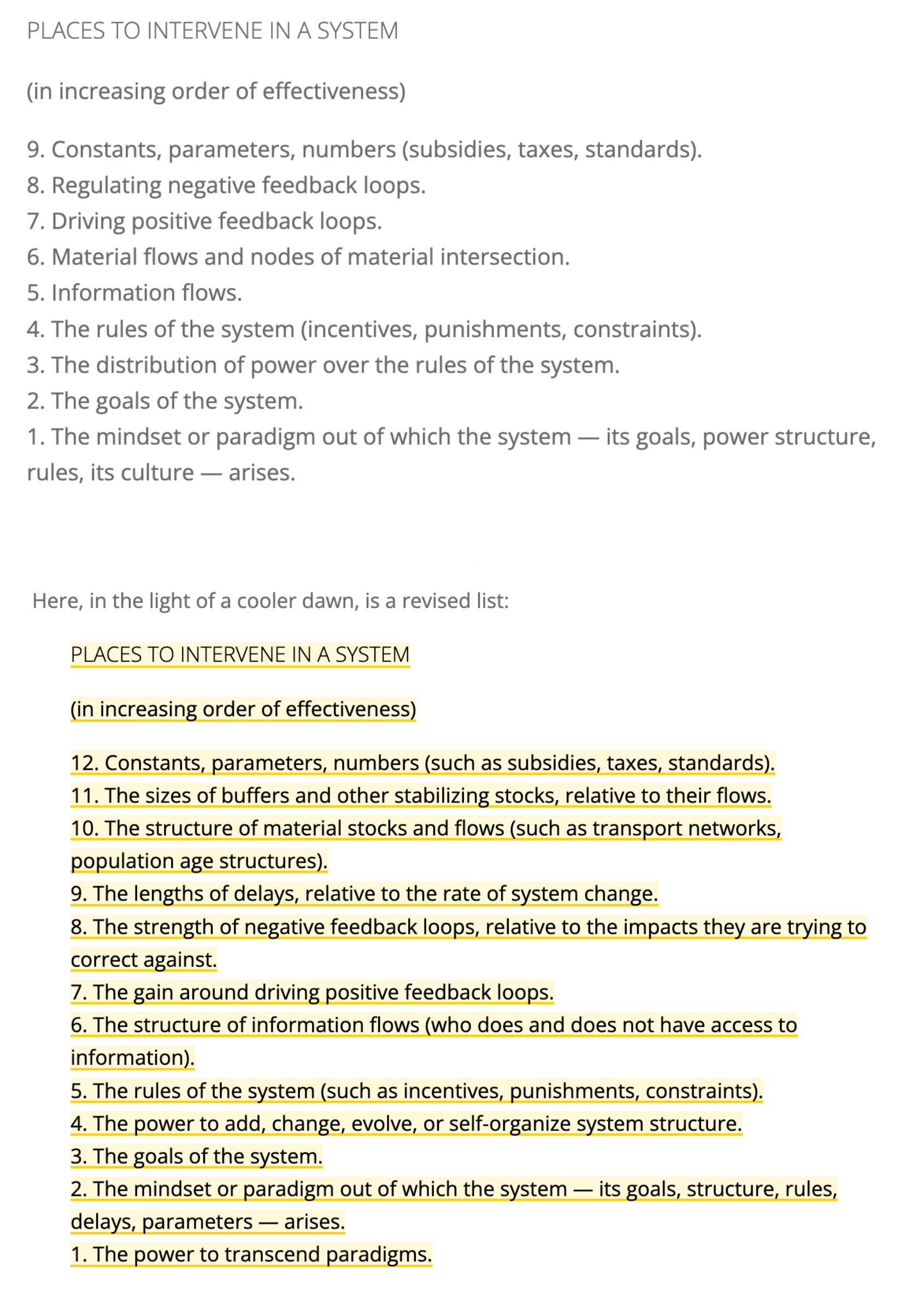
System leverage points are places within a complex system where a small, well-targeted shift can produce large changes across the whole. The concept was developed by systems thinker Donella Meadows, who ranked twelve types of intervention from the shallowest and most obvious to the deepest and most transformative. Her central, counter-intuitive lesson is that the interventions people reach for most readily — adjusting numbers like taxes, subsidies and standards — are the weakest, while the highest-leverage shifts are the hardest to see and the most fiercely resisted. “Leverage points are points of power,” she wrote, yet pushing them intuitively often moves the system in exactly the wrong direction.
Donella Meadows:
 Source: donellameadows.org · CC BY-NC-ND 4.0
From shallow to deep
Meadows arranged the twelve points on a spectrum. At the shallow end sit parameters — constants, buffer sizes, material stock-and-flow structures and delays. In the middle lies the feedback and information layer: the strength of balancing and reinforcing loops, and the structure of information flows. Deeper still comes the design layer of rules (incentives, punishments, constraints) and the power to self-organise and evolve new structure. At the deepest end sits the intent layer — the system’s goals, the paradigm or mindset out of which it arises, and finally the power to transcend paradigms altogether. Mastery, she cautioned, lies less in forcing any single point than in strategically, even profoundly, letting go.
Also see Leverage points and The Iceberg Model