Socio-technical Transition Theory explains how large-scale societal systems — energy, mobility, food, housing — shift from one dominant configuration to another over time. Developed by sustainability-transitions scholar Frank Geels, it is built around the multi-level perspective (MLP), which reads transition as the interplay of three nested levels rather than the result of any single lever.
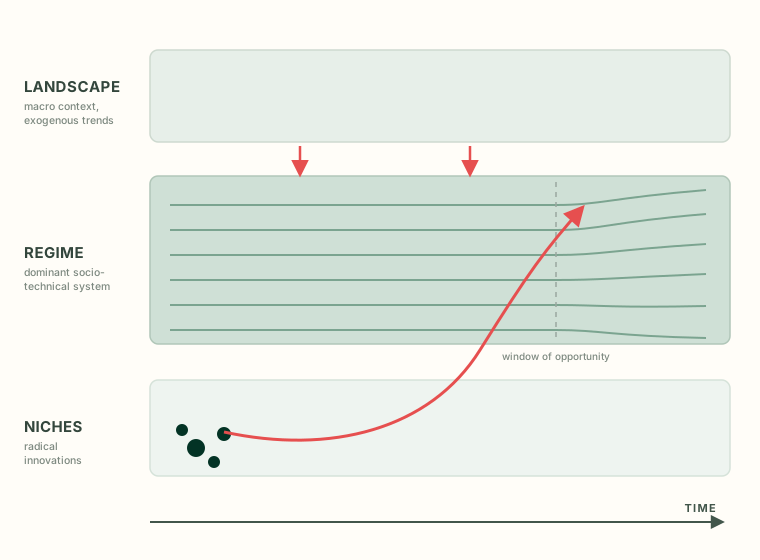 Redrawn for Deep Garden — after Geels (2002). Original at medium.com ↗
The three levels
The niche holds local experiments — new practices, technologies and lifestyles incubated away from mainstream pressures. The regime is the entrenched core: the dominant frameworks, rules and norms embedded in institutions, infrastructure and markets. The landscape is the slow-moving backdrop of values, ideologies, demographics and economic context. Transitions occur when niche innovations gain momentum and landscape pressures open cracks in the regime, so meaningful change requires coordinated effort at all three levels at once, from multiple points in the system.
Writing for Refuge for Systems Leaders, Tatiana Fraser and Juniper Glass adapt Geels’ model for social movements, arguing it overlooks the grassroots cultural and relational work that transformation depends on. They add a fourth foundational layer — a Deep Roots System of lived experience, healing, community empowerment and intersectionality — and centre “scaling deep”: shifting cultural and personal mindsets, not only top-down policy.
Also see Multi-level perspective and System Shift - Three Levels