How Embodiment Transforms Systems Change
Summary
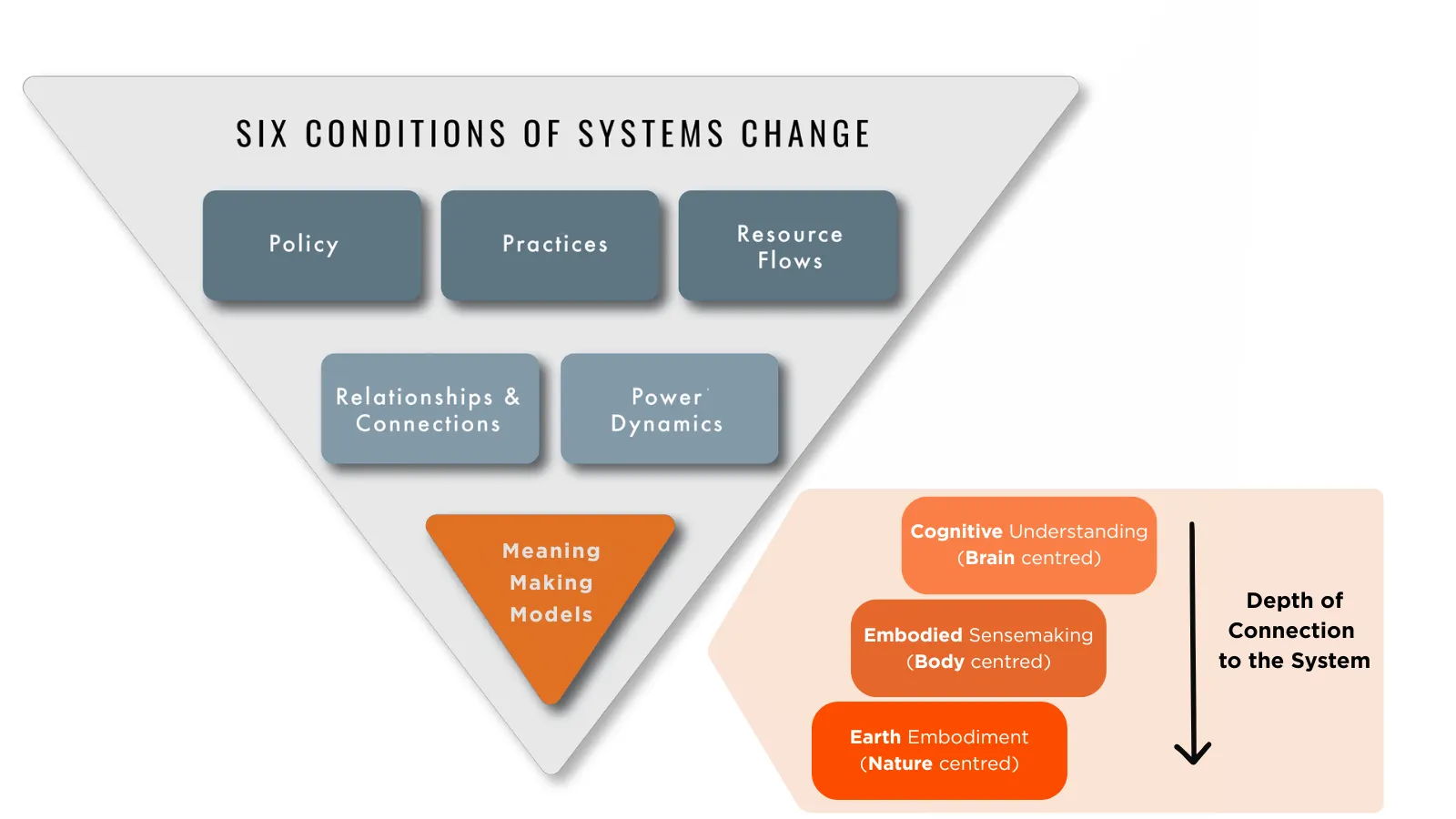
An argument that systems change practice is stuck in the equivalent of teaching by “drills, rewards, and punishments”, and “must evolve beyond predominantly cognitive approaches”. Drawing on Indigenous and wisdom traditions alongside recent science on emotion, breath and trauma, the authors make the case for “embodied sensemaking”: “an integrative way of understanding that includes signals from the body, emotions, mind, spirit, relationships, and Earth.” Revisiting the widely used Six Conditions of Systems Change framework, which co-author John Kania developed with Mark Kramer and Peter Senge, they suggest renaming its deepest condition, mental models, as “meaning-making models”, running from cognitive understanding through embodied sensemaking to ‘Earth embodiment’. As well as offering new frames, changemakers can “help people into a new relationship”, “a new experience” and, since so much meaning-making is “led by trauma”, “help people to heal”. Because, “contrary to popular belief, rather than thinking ourselves into a new way of living, we typically live ourselves into a new way of thinking.”
Rationale
If you’ve used the Six Conditions framework, and plenty of us have, it’s worth seeing where one of its authors has taken it. It resonates strongly with what we’ve found, from a different direction: the deepest layer of change isn’t only in our heads, and the work starts with us.
 Source: collectivechangelab.medium.com
✳ This entry was drafted with AI assistance and reviewed before publishing. See Rights.