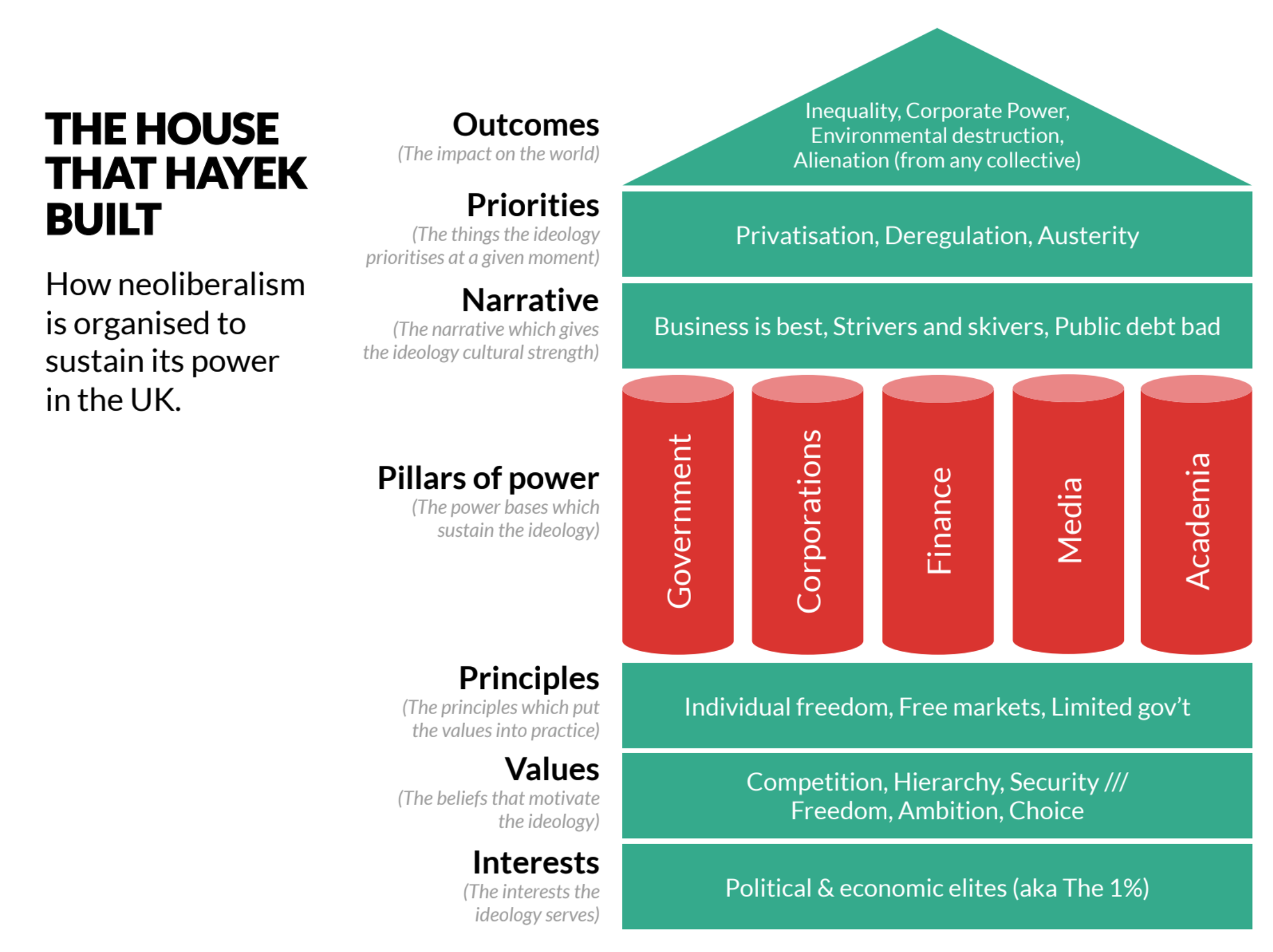
The House That Hayek Built is a framing device created by the New Economy Organisers Network (NEON) in 2016 to show, in its own words, “how neoliberalism is organised to sustain its power in the UK.” Named for the economist Friedrich Hayek, whose free-market ideas the New Right built into political common sense, it maps the ideology as a house in which every layer — from hidden foundations to visible roof — holds the others in place. The point is that neoliberalism is a coherent, self-reinforcing structure, not a loose bundle of policies, and cannot be dismantled by attacking any single storey alone.
 Source: quaker.org.uk · Creative Commons (NEON)
Originally designed by NEON, 2016
Read from the ground up, the house rests on the interests it serves — political and economic elites, the 1% — and the values that motivate it: competition, hierarchy, freedom, ambition, choice. These harden into principles: individual freedom, free markets, limited government. Five pillars of power — government, corporations, finance, media and academia — hold the structure up. Resting on them are the narrative that lends cultural strength (business is best; strivers and skivers; public debt is bad), the priorities of privatisation, deregulation and austerity, and finally the outcomes that form the roof: inequality, corporate power, environmental destruction and alienation. Naming each layer helps organisers see where a rival house of the new economy might be built instead.
Also see The House of Modernity and Cultural Hegemony