Summary
Ecological systems theory holds that a child develops within a set of nested environments that shape one another, so development can’t be understood from the child alone. The developmental psychologist Urie Bronfenbrenner set it out in the late 1970s, in ‘The Ecology of Human Development’ (1979), picturing the layers as “a set of Russian dolls”.
The microsystem is the immediate setting: family, school, peers. The mesosystem is the links between those settings; the exosystem, places the child never enters but is affected by, such as a parent’s workplace; the macrosystem, the wider culture. He later added time, the chronosystem, and turned towards the everyday interactions that drive development.
Rationale
Part 2 lays its zones onto nested circles of ‘Self’, ‘Community’ and ‘Society’. Its footnote calls ‘micro, meso, macro’ a simplification of this theory, and admits such mapping is “reductive and limited”.
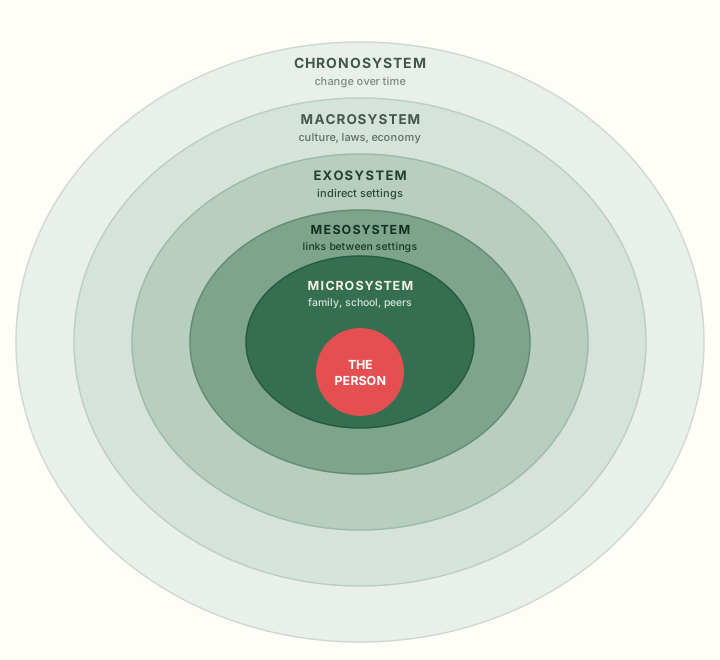 Redrawn for Deep Garden — after Bronfenbrenner. Original at simplypsychology.org ↗