Summary
The Behavioural Drivers Model (BDM) is a practitioner’s map of why people do what they do, written by Vincent Petit and published by UNICEF’s Middle East and North Africa office in 2019. It gathers existing behavioural theories into one diagram and sorts drivers under three headings: psychology, sociology and environment. Its purpose is to stop programmes defaulting to a communication campaign whatever drives the behaviour.
Its deepest layer is ‘meta-norms’, which Petit defines as “underlying ideologies and unwritten rules, deeply entrenched in people’s culture and identity”, with patriarchy as his example. He offers the model as a tool and warns it is not “a blueprint of how behaviours unfold”.
Rationale
Petit argues from inside programme design what Part 1 argues about culture: “communications alone” rarely work. We part on shape. His diagram reads left to right towards one person’s action; we describe “a recursive process”.
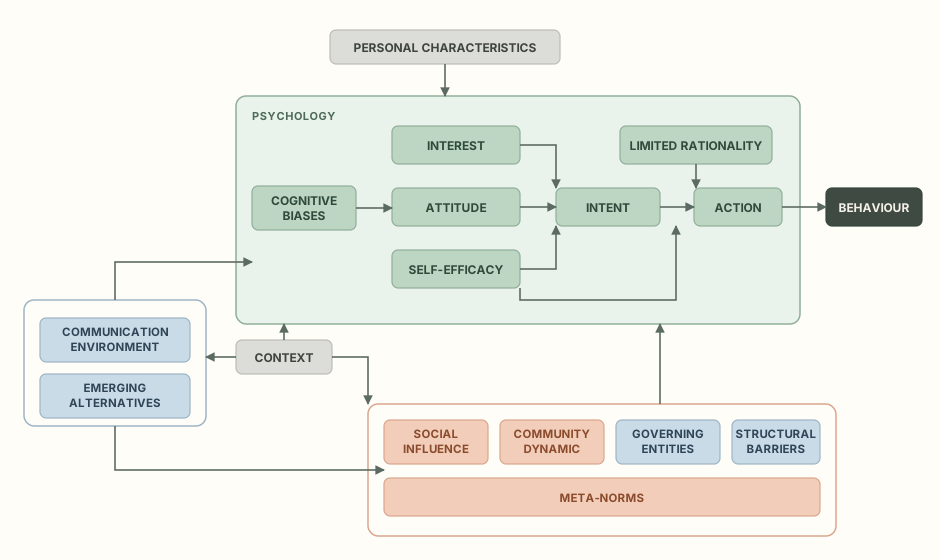 Redrawn for Deep Garden — after Petit (2019), UNICEF. Original at unicef.org ↗